Introduction
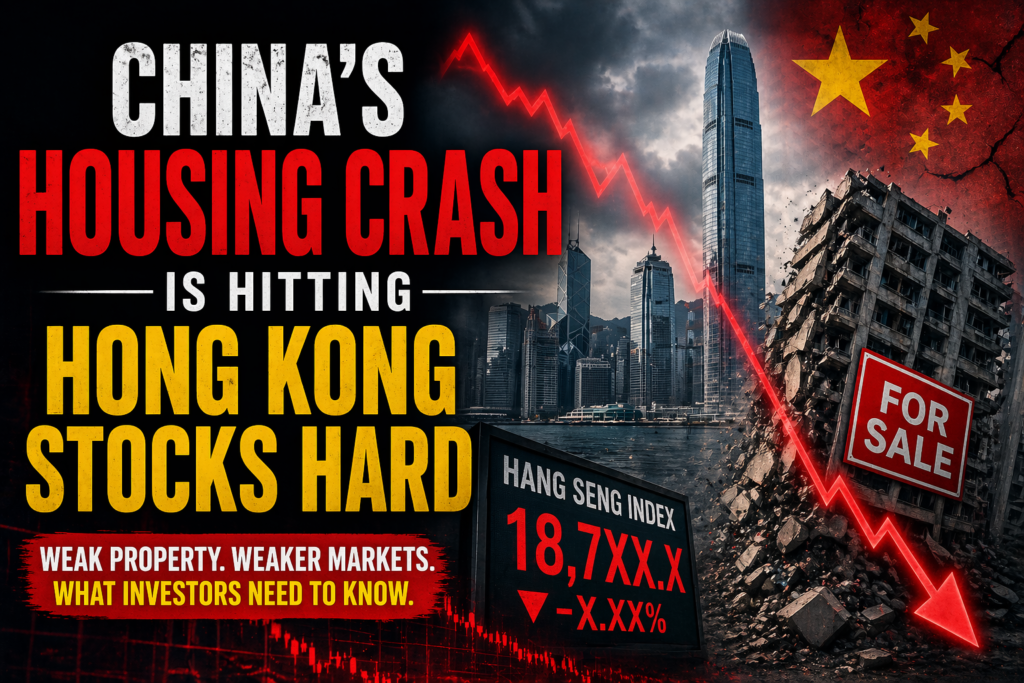
China’s real estate sector—once a cornerstone of its economic expansion—is now at the center of a prolonged financial and structural crisis. What began as a policy-driven effort to rein in excessive debt has evolved into a multi-year drag on growth, investor confidence, and regional financial markets. Among the most exposed is Hong Kong’s flagship equity benchmark, the Hang Seng Index.
While headlines often warn of imminent collapse, the reality is more nuanced: the Hang Seng is not facing a sudden crash, but rather a sustained period of volatility and suppressed valuations driven by deep-rooted issues in China’s property market.
The Origins of the Crisis
The turning point came in 2020 when Chinese regulators introduced the “three red lines” policy—a set of strict leverage thresholds aimed at curbing reckless borrowing by property developers. The policy quickly exposed the fragility of highly leveraged firms, most notably China Evergrande Group.
The consequences were immediate:
- Developers faced severe liquidity shortages
- Debt defaults surged across the sector
- Construction activity slowed dramatically
- Housing prices began a prolonged decline
Real estate, which once accounted for an estimated 20–25% of China’s economic activity (directly and indirectly), shifted from being a growth engine to a systemic liability.
Why the Hang Seng Index Is Vulnerable
1. Sector Concentration Risk
The Hang Seng Index is heavily weighted toward financial institutions and property-related companies—many of which have deep exposure to mainland China. This creates a structural sensitivity to property market stress.
When real estate weakens, it directly impacts:
- Developer earnings
- Bank loan performance
- Investor sentiment toward China-linked assets
2. Banking Sector Exposure
Hong Kong-listed banks play a critical intermediary role in financing Chinese developers. As defaults increase, these institutions face:
- Rising non-performing loans
- Declining collateral values
- Reduced credit demand
This dynamic amplifies downside risk, as financial stocks form a significant portion of the index.
3. Cross-Border Contagion
The crisis is no longer confined to mainland China. Hong Kong’s own property market is experiencing:
- Refinancing pressures
- Elevated debt risks among developers
- Softer demand due to economic uncertainty
This creates a feedback loop where weakness in China spills into Hong Kong—and vice versa.
Current Market Signals
Recent market behavior reflects these underlying stresses:
- The Hang Seng Index has struggled to sustain upward momentum
- Valuations remain below historical averages
- Investor sentiment is highly reactive to policy announcements
Rather than a sharp downturn, the index is experiencing a “grinding repricing”—a slow adjustment to weaker long-term growth expectations.
Policy Response and Partial Stabilization
Chinese authorities have begun to shift their stance, introducing measures to stabilize the sector:
- Relaxation of earlier debt constraints
- Targeted support for developers
- Incentives to boost homebuyer demand
There are early signs of stabilization in major urban centers, but lower-tier cities continue to face oversupply and declining prices.
Structural Challenges Remain
Despite policy intervention, several long-term issues persist:
- Oversupply in smaller cities
- High household exposure to property assets
- Weak consumer confidence
- Demographic headwinds reducing housing demand
These factors suggest that recovery will be gradual rather than rapid.
Outlook for the Hang Seng Index
The key question is not whether the Hang Seng will collapse, but how long it will remain under pressure.
Likely Scenario:
- Continued volatility
- Periodic rallies driven by policy optimism
- Downside risks tied to credit events and developer failures
What Could Change the Trajectory:
- A sustained rebound in housing demand
- Successful restructuring of major developers
- Improved transparency and confidence in financial markets
Conclusion
China’s real estate crisis represents a structural shift rather than a cyclical downturn. For the Hang Seng Index, this translates into a prolonged period of adjustment marked by uncertainty and constrained upside.
Investors should recalibrate expectations: the era of property-driven growth is fading, and the index’s future performance will depend increasingly on how effectively China transitions to new economic drivers.
Until then, the Hang Seng remains under pressure—not from a single shock, but from the slow unwinding of one of the largest property booms in modern history.