Below is a ready‑to‑publish, SEO‑friendly web article on South Africa’s fuel price forecast. It is written in neutral news style, suitable for an online publication, company website, or blog.
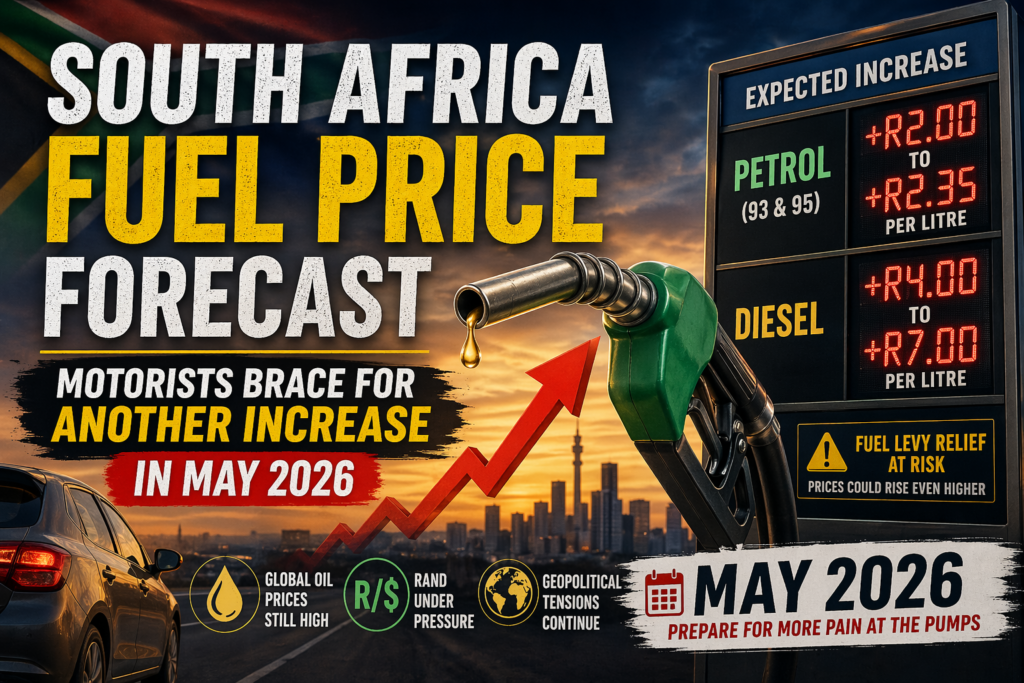
South African motorists are set to face another round of fuel price increases in May 2026, with early indicators pointing to moderate petrol hikes and significantly steeper diesel increases. Although price pressure has eased compared to early‑April “worst‑case” scenarios, fuel costs remain firmly on an upward trajectory as global oil markets stay volatile and South Africa’s reliance on imported fuel continues to weigh on local prices. [businesstech.co.za], [stuff.co.za]
Expected Fuel Price Changes from 6 May 2026
Based on the latest data from the Central Energy Fund (CEF), which tracks daily fuel price over‑ and under‑recoveries, the following increases are currently expected if market conditions hold until month‑end:
- Petrol 93: increase of roughly R1.80 to R1.90 per litre
- Petrol 95: increase of around R2.10 to R2.20 per litre
- Diesel (0.05% and 0.005% sulphur): increase of approximately R5.90 to R6.30 per litre
- Illuminating paraffin: increase of about R5.00 per litre
These projected changes reflect the under‑recovery levels recorded toward the end of April, which have improved substantially since the middle of the month but remain deeply negative, particularly for diesel. [businesstech.co.za], [businesstech.co.za]
Fuel prices in South Africa are officially adjusted on the first Wednesday of every month, meaning the new prices are scheduled to take effect on Wednesday, 6 May 2026.
What Is Driving the Fuel Price Increase?
Global Oil Prices Remain the Biggest Factor
The dominant driver behind the expected increases is the international price of petroleum products, which is closely linked to global crude oil prices. In recent weeks, Brent crude has climbed back above the $100 per barrel mark, driven by ongoing geopolitical instability in the Middle East and renewed concerns about supply disruptions through the Strait of Hormuz, a key global oil shipping route. [businesstech.co.za], [thesouthafrican.com]
According to CEF data, international petroleum product prices account for almost the entire fuel price under‑recovery, meaning local price movements are being dictated far more by global markets than domestic factors at present. Even brief spikes in oil prices tend to feed rapidly into South Africa’s fuel cost calculations due to the country’s net importer status. [businesstech.co.za]
The Rand Offers Limited Relief
The rand–US dollar exchange rate has played a secondary, but still important, role. After trading below R16.00 to the dollar earlier in the year, the rand weakened following renewed geopolitical risk and is now hovering in the R16.50–R16.70 range. While the currency has remained relatively stable in recent sessions, it has not strengthened enough to offset the impact of higher oil prices. [businesstech.co.za]
Currency volatility remains a risk factor going into the final days of the April fuel price review period. Any sharp depreciation could still worsen the final numbers.
Diesel Continues to Bear the Brunt
While petrol users are facing uncomfortable increases, diesel consumers are once again the hardest hit. Wholesale diesel prices have been under particular pressure due to global refining constraints and strong international demand, which tends to push up diesel prices faster and more aggressively than petrol.
Economists warn that diesel price spikes have wider economic consequences than petrol increases. Higher diesel costs feed directly into freight transport, agriculture, mining, and manufacturing, raising the cost of moving goods across the country and eventually driving up food and consumer prices. [businesstech.co.za], [autotrader.co.za]
Will Government Step In Again?
In April, National Treasury introduced a temporary R3.00 per litre cut to the general fuel levy, cushioning motorists from what would otherwise have been record‑breaking price increases. That intervention, however, was costly and was always described as temporary.
Market analysts and economists say there is fiscal room for a short‑term extension or phased withdrawal of the levy cut, but as of late April, no official confirmation has been made. Should the levy relief fully expire in May, motorists could face higher pump prices than current forecasts suggest. [stuff.co.za], [businesstech.co.za]
The final outcome will depend on political and budgetary decisions taken in the days leading up to the official price announcement.
When Will Prices Be Confirmed?
Although the fuel price adjustment takes effect on 6 May, the Department of Mineral Resources and Energy (DMRE) typically publishes the final prices two to three days beforehand, usually on the Monday or Tuesday of the adjustment week. This gives motorists and businesses some advance notice to plan for the change. [stuff.co.za]
Outlook Beyond May
Looking further ahead, fuel price relief will depend on three key factors:
- Stability in global oil markets, particularly any easing of Middle East tensions
- A stronger rand, which could soften import costs
- Domestic policy decisions, including fuel levies and tax relief
Until there is sustained improvement on at least two of these fronts, fuel prices are likely to remain elevated and volatile through the middle of 2026.
Bottom Line
South Africans should prepare for another fuel price increase in May, with diesel users facing the steepest impact. While recent market improvements have reduced the size of expected petrol hikes, global oil prices remain high and volatile, keeping pressure firmly on local fuel costs. Unless government intervention returns, higher transport and living costs are likely to persist into winter.