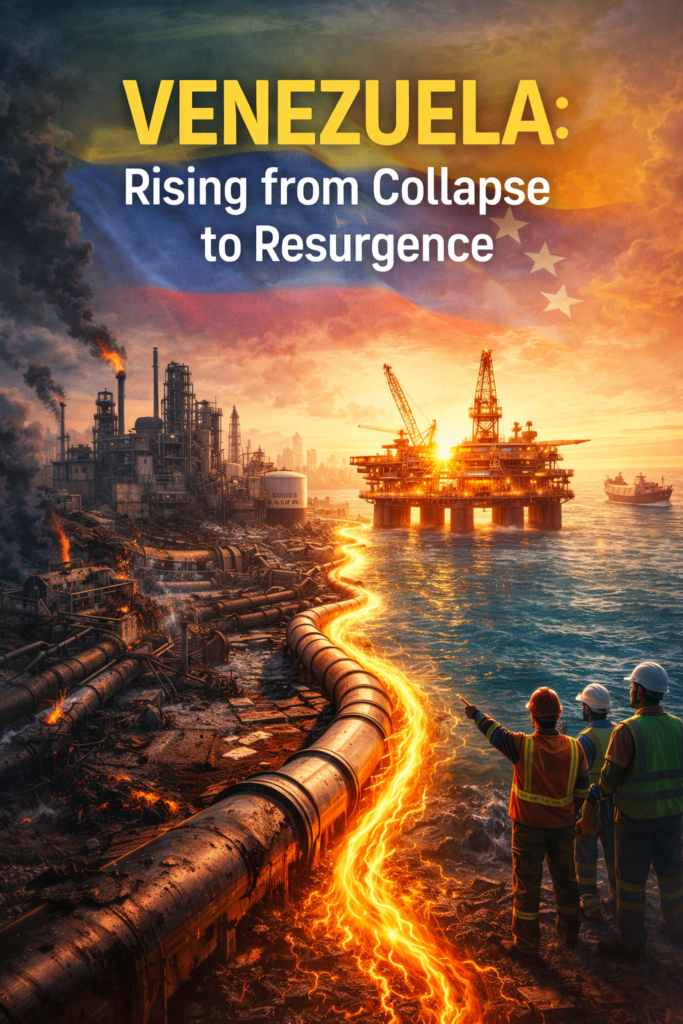
For much of the past decade, Venezuela stood as a cautionary tale—an oil-rich nation brought to its knees by economic mismanagement, political turmoil, and international isolation. Today, however, a new narrative is beginning to emerge: one of cautious recovery, renewed global interest, and the possibility of resurgence.
From Oil Giant to Economic Collapse
Venezuela was once one of the world’s leading oil producers, pumping more than 3 million barrels per day at its peak. But years of underinvestment, corruption, and political instability—compounded by international sanctions—caused production to collapse to below 1 million barrels per day. (Energy Tribune)
The consequences were devastating:
- Hyperinflation wiped out savings
- Infrastructure deteriorated
- Millions of citizens fled the country
- The state oil company, PDVSA, became a shadow of its former self
Importantly, analysts note that the decline began long before sanctions, rooted in systemic mismanagement and the politicization of the oil industry. (Al Jazeera)
A Turning Point: Reform and Reopening
The year 2026 marks a significant shift. Venezuela has begun opening its oil sector to foreign investment, reversing decades of strict state control. (Energy Tribune)
Key developments include:
- New laws allowing greater participation by international oil companies
- Efforts to rebuild relationships with global financial institutions
- Early talks of IMF re-engagement after years of isolation (Reuters)
At the same time, major energy firms are cautiously returning.
These reports highlight:
- European and American companies seeking operational control of oil projects
- Production recovering toward 1.1–1.2 million barrels per day
- Growing optimism among investors and workers on the ground
The Role of Global Geopolitics
Venezuela’s recovery is not just economic—it is deeply geopolitical.
With the largest proven oil reserves in the world (over 300 billion barrels), Venezuela is once again attracting attention from global powers. (Talento Petrolero)
Several factors are shaping this renewed interest:
- Shifts in U.S. foreign policy and sanctions relief
- Europe’s search for alternative energy sources
- China and other emerging markets seeking secure oil supplies
This intersection of domestic reform and global demand is placing Venezuela back at the center of the global energy map.
Signs of Recovery
While still fragile, the recovery is becoming visible:
- Oil output is gradually rising, with targets exceeding 1.1 million barrels/day in 2026 (Energy Tribune)
- Foreign investment deals are being negotiated across oil and gas projects (Talento Petrolero)
- Economic indicators, including inflation and growth, are stabilizing modestly
There is also renewed confidence in financial markets, with Venezuelan bonds gaining value following signs of institutional reform. (Reuters)
The Harsh Reality: Recovery Will Take Time
Despite the optimism, Venezuela’s path forward is anything but easy.
Experts warn:
- The oil industry requires tens of billions of dollars in investment
- Infrastructure is severely degraded
- Production growth will take years, not months (World Oil)
Even under favorable conditions, a return to historic production levels could take over a decade and require massive capital and institutional reform.
The Political Question
Economic recovery alone is not enough. Investors remain cautious due to:
- Weak legal protections
- A history of nationalization
- Ongoing political uncertainty
Sustainable resurgence depends on credible governance, transparency, and democratic stability—without which long-term investment will remain limited. (The Washington Post)
A Nation at a Crossroads
Venezuela today stands between two futures:
- One path leads to renewed prosperity, driven by reform, investment, and global integration
- The other risks relapse, if political instability undermines progress
The difference will depend not only on oil—but on institutions, leadership, and trust.
Conclusion
Venezuela’s story is no longer just about collapse. It is about potential rebirth.
The country holds unmatched natural wealth, renewed international attention, and a rare second chance to rebuild. But resurgence is not guaranteed—it must be earned through sustained reform, stability, and strategic partnerships.
In the end, Venezuela’s rise will not be measured only in barrels of oil—but in whether it can transform resource wealth into lasting national prosperity.