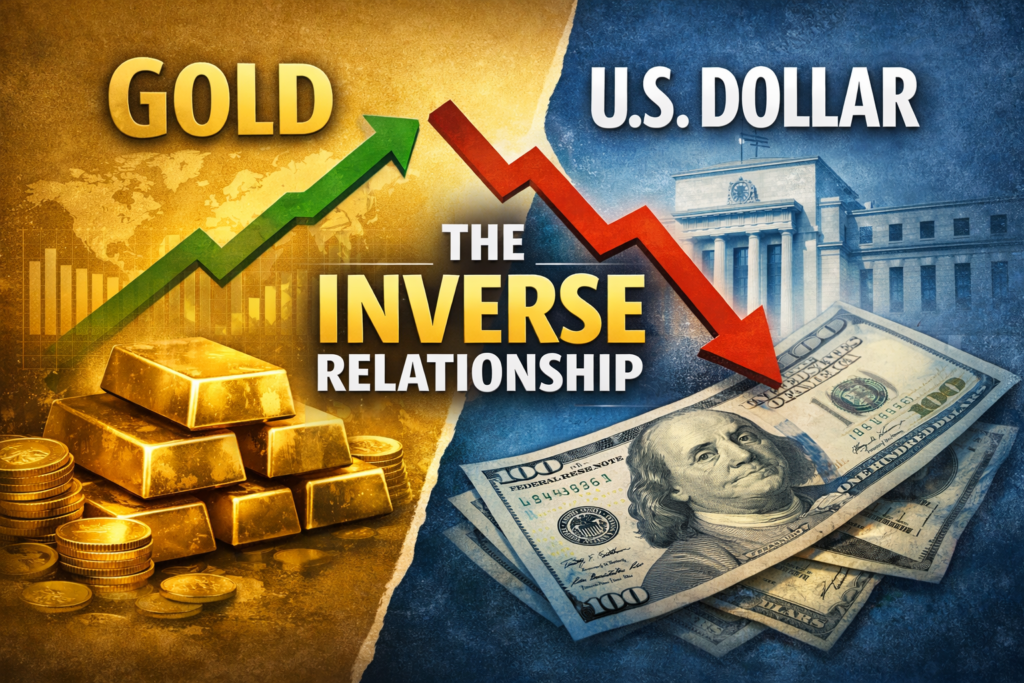
At the heart of global financial markets lies a powerful and often reliable dynamic: the inverse relationship between gold and the US dollar. Understanding this relationship is key to interpreting movements in commodities, currencies, and even broader economic sentiment.
Why Gold and the US Dollar Move Oppositely
Gold is priced internationally in US dollars. This creates a natural link between the two:
- When the US dollar strengthens, gold becomes more expensive for buyers using other currencies → demand tends to fall → gold prices decline.
- When the US dollar weakens, gold becomes cheaper globally → demand increases → gold prices rise.
This mechanism alone explains much of the inverse behavior—but it’s only part of the story.
The Role of Interest Rates
The Federal Reserve plays a central role in shaping this relationship.
- Rising interest rates → stronger dollar + higher bond yields → gold becomes less attractive (it pays no interest)
- Falling interest rates → weaker dollar + lower yields → gold becomes more attractive
This is why gold often rallies when markets expect rate cuts.
Real Yields Matter More Than Nominal Rates
Gold responds more strongly to real interest rates (interest rates adjusted for inflation).
- If inflation rises faster than interest rates → real yields fall → bullish for gold
- If interest rates rise faster than inflation → real yields increase → bearish for gold
In simple terms:
Gold thrives when money loses real value.
Safe Haven vs Reserve Currency
Both gold and the US dollar are considered “safe-haven” assets—but they behave differently depending on the situation:
- In short-term crises, investors often rush into the US dollar for liquidity
- In prolonged uncertainty or loss of confidence in fiat systems, gold becomes the preferred store of value
This creates moments where both can rise—but over time, the inverse trend usually reasserts itself.
When the Relationship Breaks Down
The inverse relationship is strong—but not absolute.
It can weaken or temporarily reverse during:
- Extreme financial crises
- Sudden liquidity shocks
- Coordinated global monetary tightening
In these moments, both gold and the dollar may rise together as investors seek safety.
The Strategic Takeaway
For investors and analysts, the gold–dollar relationship provides a powerful lens:
- Strong dollar environment → caution on gold
- Weak dollar environment → opportunity for gold
But the smartest approach is to watch the drivers behind the dollar—interest rates, inflation, and global confidence—because that’s where the real signals emerge.