
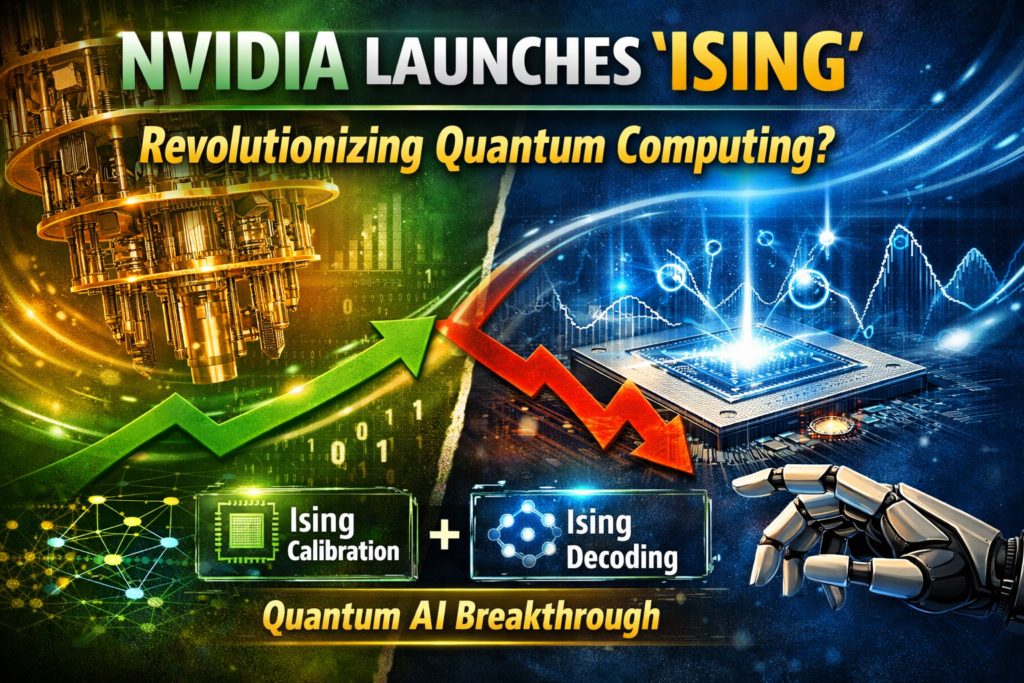
Short answer: not exactly.
The Ising model isn’t a new product. It’s a long-established concept in physics used to model systems of interacting spins—commonly applied in optimization problems and as a foundation in quantum computing research.
What Nvidia Actually Did
What Nvidia has been doing is far more grounded—but still important:
- Developing GPU-accelerated tools to simulate quantum systems
- Supporting hybrid computing (classical + quantum workflows)
- Enhancing platforms like CUDA and cuQuantum for research and optimization
These tools can solve Ising-type problems faster using classical hardware, which is useful in logistics, finance, and AI.
Why the Ising Model Matters
The Ising Model is central because:
- Many real-world problems (routing, scheduling, portfolio optimization) can be mapped onto it
- Quantum computers often use Ising formulations to find optimal solutions
- Classical systems (like GPUs) can approximate these solutions efficiently
So yes—it’s powerful. But it’s not new, and it’s not exclusive to Nvidia.
Is This a Quantum Breakthrough?
Not quite.
A true quantum computing revolution would involve:
- Stable, scalable qubits
- Error correction breakthroughs
- Demonstrated advantage over classical systems at scale
Companies like IBM, Google, and D-Wave Systems are actively working on those fronts.
Nvidia’s contribution is more about enabling and accelerating the ecosystem, not replacing it.
What This Means in Practice
This development signals something important:
👉 The future of computing is likely hybrid, not purely quantum.
- Classical GPUs (like Nvidia’s) handle large-scale simulation
- Quantum systems tackle niche, complex optimization
- The Ising model acts as a bridge between the two
The Bottom Line
Calling this a “revolution” is a stretch.
But it is a meaningful step:
- It makes quantum-inspired computing more accessible
- It speeds up research and experimentation
- It helps bridge the gap between today’s hardware and tomorrow’s quantum machines