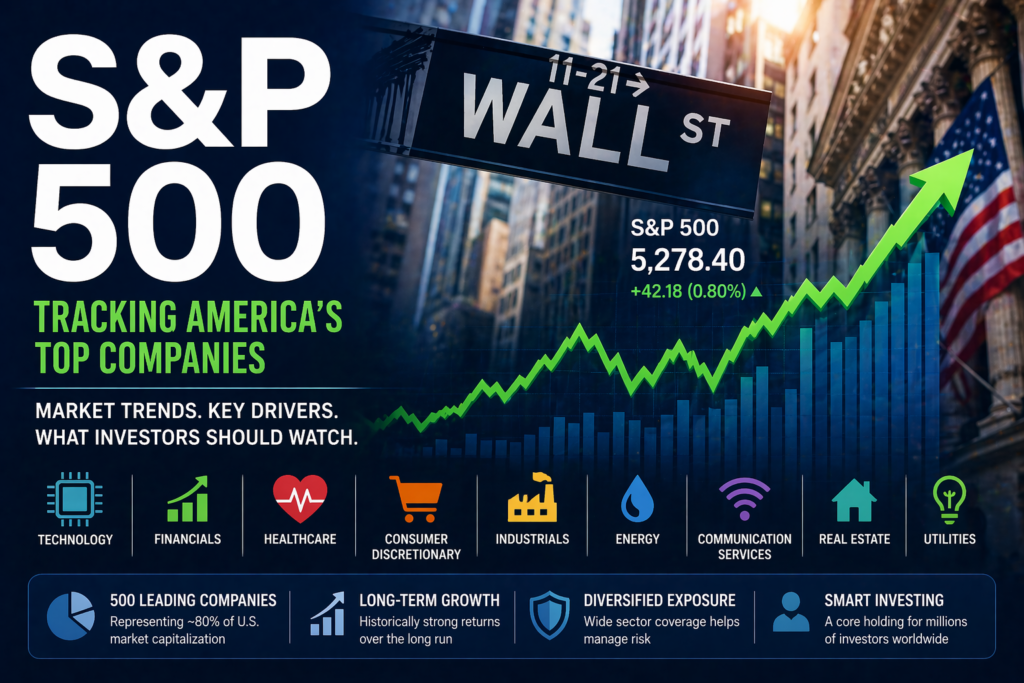
The S&P 500 is widely regarded as the most important benchmark for the U.S. stock market. Tracking the performance of 500 of the largest publicly traded companies, it provides a snapshot of the overall health of the economy.
From institutional investors to everyday traders, the S&P 500 plays a central role in guiding investment decisions across the globe.
🏢 What the S&P 500 Represents
The index includes companies from all major sectors, making it highly diversified.
🔑 Key Sectors:
- Technology
- Financials
- Healthcare
- Consumer goods
- Energy
- Industrial companies
👉 Because of this broad coverage, the S&P 500 is often used as a proxy for the U.S. economy.
📈 Why the S&P 500 Matters
💡 Key Reasons Investors Follow It:
- Measures overall market performance
- Acts as a benchmark for fund managers and portfolios
- Influences retirement accounts, ETFs, and index funds
👉 If the S&P 500 rises, it generally signals economic growth and investor confidence.
🚀 What’s Driving the Market in 2026
🤖 1. AI and Technology Boom
Major tech companies are leading gains, especially those involved in:
- Artificial intelligence
- Cloud computing
- Semiconductor manufacturing
👉 These companies now have significant weight in the index, heavily influencing its direction.
💰 2. Interest Rates and Inflation
- Central bank policies remain a key driver
- Higher rates can slow growth, while lower rates boost stocks
👉 Investors are closely watching inflation data and policy signals.
🌍 3. Global Economic Conditions
- Trade relationships
- Geopolitical tensions
- Supply chain stability
👉 Global events can quickly impact the S&P 500.
⚠️ Risks and Volatility
Even though the index is diversified, it’s not risk-free.
🔴 Key Risks:
- Market corrections after strong rallies
- Overvaluation in tech stocks
- Economic slowdowns or recession fears
👉 Short-term volatility is normal, even in long-term uptrends.
💰 How to Invest in the S&P 500
You can’t invest directly in the index, but you can gain exposure through:
- ETFs (e.g., SPY, VOO)
- Index funds tracking the S&P 500
👉 These options offer low-cost diversification and are popular for long-term investing.
📊 Long-Term Performance
Historically, the S&P 500 has delivered:
- Average annual returns of ~8–10% over the long term
- Strong recovery after market downturns
- Consistent growth driven by innovation and economic expansion
🧭 What This Means for Investors
📌 For Long-Term Investors:
- The S&P 500 remains a core portfolio investment
- Ideal for steady growth and diversification
📌 For Traders:
- Watch key levels, earnings reports, and macro data
- Expect short-term swings driven by news and sentiment
🏁 Final Thoughts
The S&P 500 continues to be the backbone of global investing. Whether you’re a beginner or experienced investor, understanding how it moves is essential for navigating financial markets.
📌 Bottom Line:
The S&P 500 isn’t just an index—it’s a powerful indicator of economic strength, investor sentiment, and the future direction of markets.