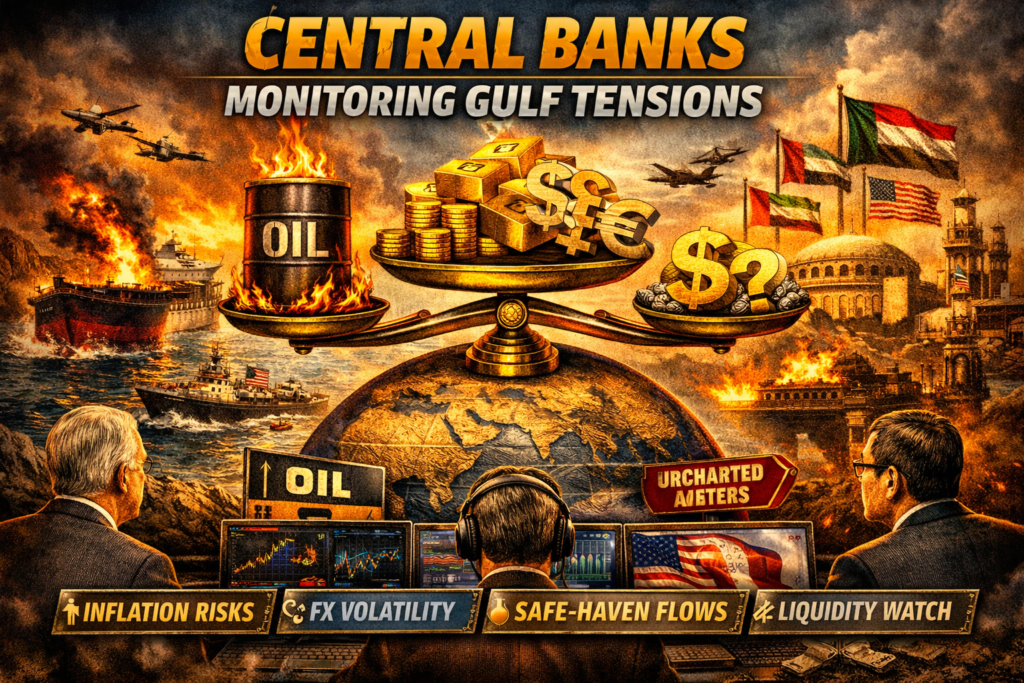
UBS’s latest commentary highlights a key macro theme in the current geopolitical environment: central banks are monitoring Middle East (Gulf) tensions closely, but are deliberately avoiding knee-jerk policy reactions.
🧠 Core UBS message
According to UBS Chief Economist Paul Donovan:
- Central banks are focused on “second-round effects”, not immediate shocks
- Policymakers are not yet seeing enough economic damage to justify policy shifts
- It is “too soon” to expect any change in interest rate guidance from major central banks (FXStreet)
In short:
They are watching, but not reacting.
⚖️ Why central banks are staying calm
UBS notes several reasons for this restraint:
1. 🛢️ Energy shock is still uncertain
- Oil price spikes are volatile and headline-driven, not structural yet
- Central banks prefer to wait for sustained inflation impact before responding
2. 📊 No clear second-round inflation effects
- Wage pressures and broader inflation pass-through are not yet visible
- ECB and BoE officials argue it is still “too early” to see lasting effects (FXStreet)
3. 🏦 Policy credibility
- Reacting too quickly to geopolitical shocks risks over-tightening or policy errors
- Central banks are prioritizing stability and patience
🌍 What major central banks are signaling
- 🇬🇧 Bank of England (BoE): softening earlier hawkish tone
- 🇪🇺 ECB: remains in wait-and-see mode
- 🇺🇸 Federal Reserve: focused on inflation trajectory, not geopolitics directly
Overall stance:
“Monitor inflation, but do not pre-emptively tighten or ease based on Gulf headlines.”
📉 Market implications
This “no overreaction” stance matters because it shapes:
💵 USD behavior
- Less aggressive tightening expectations → weaker dollar bias
🛢️ Oil sensitivity
- Oil remains market-driven, not policy-anchored
📊 Risk assets
- Equities benefit from policy stability
- Volatility is driven more by headlines than central bank shifts
🧠 Big-picture takeaway
UBS is essentially describing a policy buffer zone:
Geopolitical shocks are high in noise, but low in immediate policy transmission — so central banks are choosing patience over reaction.
This creates an environment where:
- Markets drive short-term volatility
- Central banks respond only if inflation or growth data materially changes
📌 Bottom line
Central banks are:
- 👀 Watching Gulf developments closely
- 🧊 Not reacting to short-term shocks
- ⏳ Waiting for clear inflation or growth spillovers
So the key market dynamic becomes:
Geopolitics drives volatility — but central banks only respond if it becomes economic reality.