At first glance, Hungarian politics and Middle Eastern tensions seem unrelated. But in today’s macro-driven markets, both can influence the direction of EUR/GBP through one powerful channel: risk perception.
Right now, traders are weighing two very different scenarios—each with the potential to shift the balance between the euro and the pound.
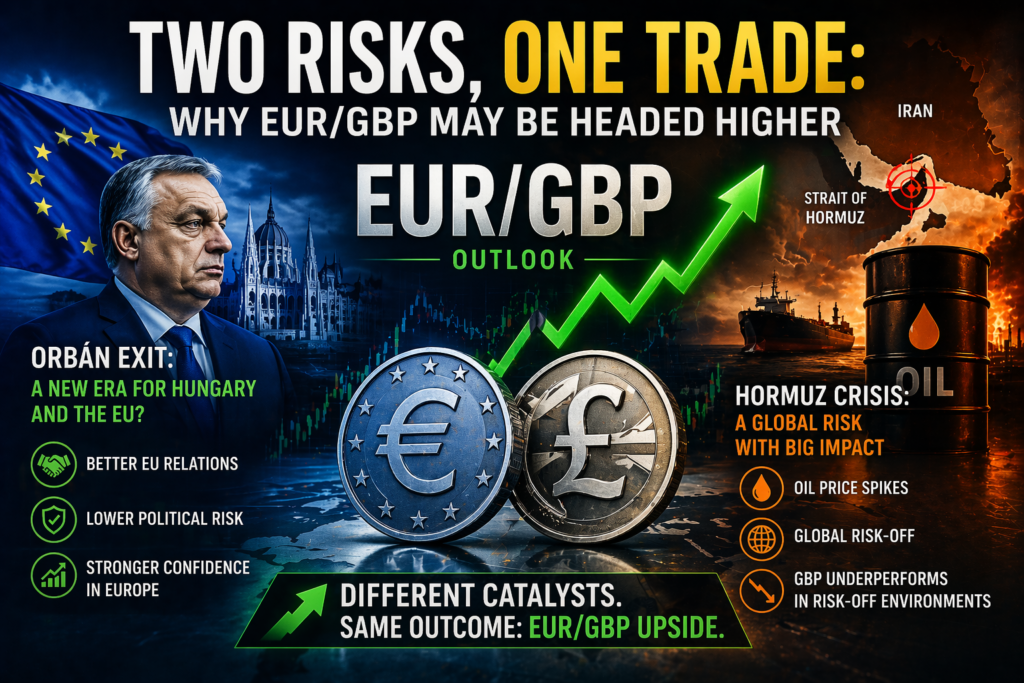
Scenario 1: A Political Shift in Hungary
The possible exit of Viktor Orbán would mark a major political turning point for Hungary—and potentially for the broader European Union.
Orbán has long been associated with:
- Tensions with EU institutions
- Rule-of-law disputes
- Friction over fiscal alignment
A leadership change could signal:
- Improved relations with Brussels
- Greater policy alignment within the European Union
- Reduced political risk premium on European assets
Market Impact
For the euro, this would likely be supportive:
- Stronger investor confidence
- Narrower risk spreads in peripheral Europe
- Increased capital inflows into euro-denominated assets
Against the pound, this could push EUR/GBP higher, especially if UK-specific factors remain neutral or negative.
Scenario 2: A Hormuz Crisis
On the other side of the equation lies geopolitical risk centered around the Strait of Hormuz—one of the world’s most critical oil transit routes.
Any disruption here, particularly involving Iran, would have immediate global consequences.
Why It Matters
- Roughly a fifth of global oil supply passes through Hormuz
- Even minor disruptions can trigger sharp price spikes
- Energy-importing economies are hit hardest
Euro vs Pound: Who’s More Vulnerable?
Both the eurozone and the UK are energy importers—but their sensitivities differ.
Eurozone Exposure
- Larger industrial base
- Higher dependence on imported energy in certain regions
- Greater fragmentation in fiscal responses
UK Exposure
- More flexible energy pricing mechanisms
- Different monetary policy dynamics via the Bank of England
- Historically more reactive currency (GBP often weakens in global risk-off)
Market Reaction
In a full “risk-off” scenario:
- Investors typically move into USD and safe havens
- Both EUR and GBP weaken—but GBP often underperforms
This means EUR/GBP could actually rise, even if the euro itself is under pressure globally.
The Key Difference: Local vs Global Shock
This is what makes the setup interesting:
- Orbán exit → Local European political improvement → EUR positive
- Hormuz crisis → Global macro shock → GBP relatively weaker than EUR
Different catalysts. Same directional bias.
What Traders Are Watching
Markets are now less reactive to headlines and more focused on probability and impact.
Key signals include:
- Concrete political developments in Hungary
- Naval or military escalation near Hormuz
- Oil price behavior (spike vs sustained trend)
- Central bank responses, especially from the European Central Bank and the Bank of England
Technical Bias Meets Macro Narrative
While fundamentals set the direction, positioning and technical levels will determine timing and magnitude.
Right now, EUR/GBP is behaving like a relative risk barometer:
- Stable environment → range-bound
- European political improvement → upside bias
- Global shock → upside via GBP weakness
Bottom Line
Despite very different origins, both scenarios point toward a similar outcome:
EUR/GBP risks skew to the upside.
But the reasoning matters:
- One is about confidence returning to Europe
- The other is about global stress exposing GBP vulnerability
Understanding that distinction is key. Because in FX markets, it’s not just about what happens—it’s about how markets interpret it.