
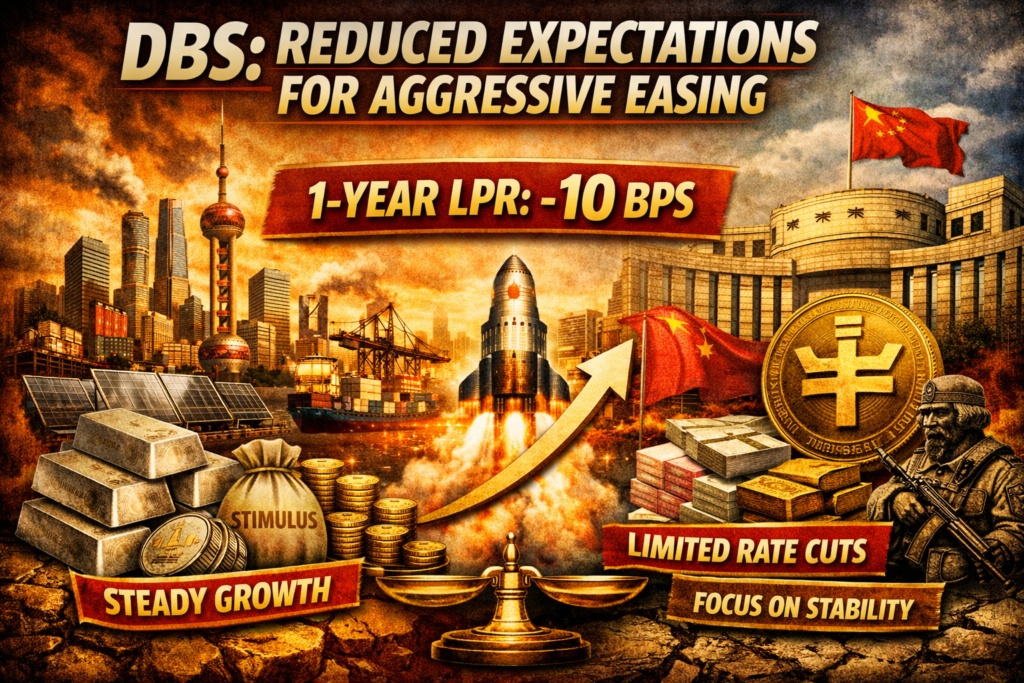
DBS has reduced expectations for aggressive monetary easing in China, signaling a shift toward a more cautious and targeted policy stance rather than broad stimulus.
🔍 What DBS is saying
DBS analysts highlight that China’s policy path is being reshaped by mixed economic signals:
- 📈 GDP growth remains resilient (~5.0% YoY in Q1 2026), supported by exports and industrial output
- 🏭 Industrial production is still solid, especially in export-linked manufacturing
- 🏠 Domestic demand remains weak, particularly consumption, investment, and property
- 📊 Inflation is improving, reducing urgency for large-scale stimulus
👉 Result: policymakers feel less pressure to aggressively cut rates
📉 Key policy revision
DBS now expects:
- Only ~10bps cut in the 1-year Loan Prime Rate (LPR) (previously 20bps expected)
- Continued preference for liquidity tools (RRR cuts, targeted lending) over headline rate cuts
- More emphasis on stability rather than stimulus expansion
⚖️ Why easing expectations are being trimmed
1. External strength
- Exports remain resilient despite global uncertainty
- Industrial production is holding up better than expected
2. Internal weakness (but not crisis-level)
- Property sector still weak
- Household confidence subdued
- Credit demand remains soft
3. Policy shift in Beijing
- Focus moving from “stimulate growth” → “manage stability and structure”
- Preference for targeted support instead of broad easing cycles
🧠 What this means for markets
💱 FX impact (CNY)
- Less aggressive easing = less downward pressure on the yuan
- More stable FX outlook in the short term
📊 Rates & liquidity
- Front-end rates likely remain anchored by liquidity injections
- Long-end yields relatively stable
🏦 Equities
- Policy support becomes sector-specific rather than broad market lifting
- Winners = infrastructure, advanced manufacturing, strategic tech
- Laggards = property-linked sectors
📌 Big picture takeaway
DBS is essentially saying:
China is not entering a major stimulus cycle — it is shifting into a controlled, liquidity-managed, structurally focused policy regime
So instead of:
- ❌ Big rate cuts and aggressive stimulus
We get:
- ✅ Small rate adjustments + liquidity injections + targeted support