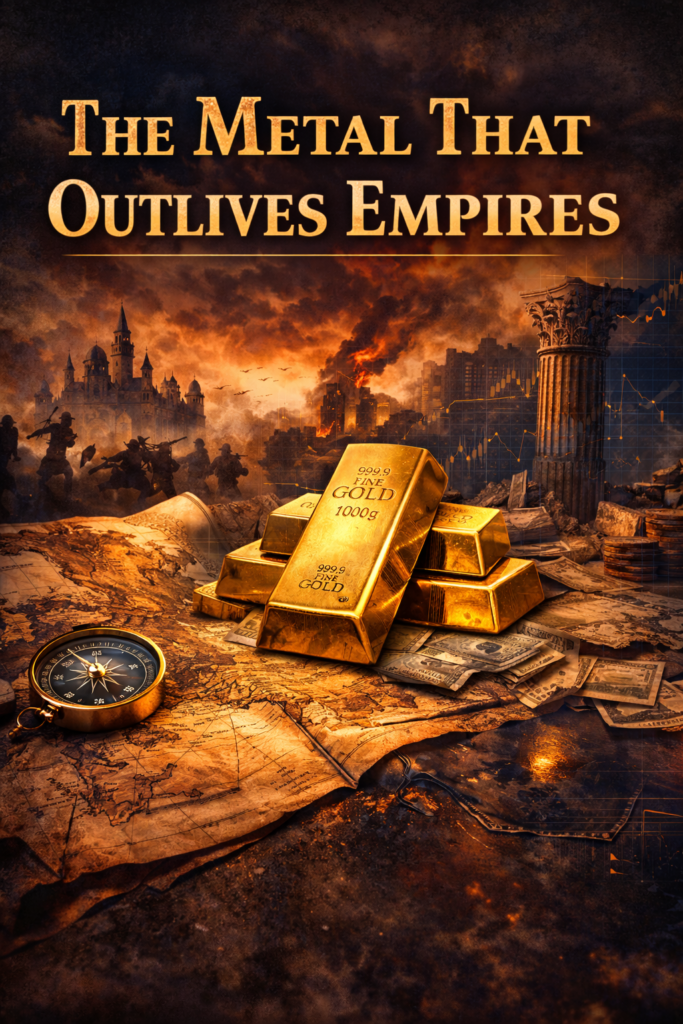
In times of war, certainty becomes a rare commodity. Borders shift, currencies weaken, and institutions strain under pressure. Yet through centuries of upheaval—from the trenches of World War I to the global devastation of World War II—one asset has consistently re-emerged as a symbol of stability: gold.
But is gold truly a safe harbor in chaos, or is its rise merely a symptom of something far more troubling?
Gold as an Anchor in Crisis
Gold’s enduring appeal lies in its independence. Unlike fiat currencies, it is not issued by governments, manipulated by central banks, or directly tied to economic policy. In wartime, when governments often resort to printing money to finance military operations, currencies can rapidly lose value. Inflation surges, purchasing power declines, and trust erodes.
Gold, by contrast, tends to hold—or even increase—its value during such periods. It becomes a universal medium of exchange when local currencies falter. Refugees have historically carried gold across borders, and nations have hoarded it as a last line of financial defense.
This “anchor” function is not about growth—it’s about preservation. Gold doesn’t create wealth; it protects it when traditional systems are under stress.
A Mirror Reflecting Monetary Instability
Yet there’s another way to interpret gold’s wartime performance—one that is less comforting.
When gold prices surge, it often reflects declining confidence in financial systems. Wartime economies typically involve massive government spending, rising debt, and expansionary monetary policies. Central banks may increase the money supply, diluting the value of currency in circulation.
In this light, gold is not the hero of the story—it’s the warning signal.
A rising gold price can indicate that investors are losing faith in fiat currencies, sovereign debt, or even the broader global financial architecture. It becomes less about gold’s intrinsic strength and more about the perceived fragility of everything else.
The Dual Nature of Gold
So which is it—anchor or alarm bell?
The answer lies in context.
- In localized conflicts, where global financial systems remain intact, gold acts as a hedge—a defensive asset that cushions against volatility.
- In systemic crises, where trust in currencies or institutions begins to fracture, gold transforms into a barometer of deeper instability.
This duality is what makes gold unique. It is both a store of value and a signal of distress, depending on the scale and severity of the crisis.
Modern Implications: A Changing Battlefield
Today’s conflicts are not only fought with weapons, but with sanctions, cyber warfare, and economic leverage. Currency systems are more interconnected than ever, and the dominance of fiat money is largely unquestioned—until it isn’t.
In this environment, gold competes with new forms of “safe haven” assets, including commodities and even digital currencies. Yet it retains a psychological and historical weight that few alternatives can match.
Central banks continue to hold gold reserves. Investors still turn to it in times of uncertainty. And when geopolitical tensions rise, gold prices often follow.
Conclusion: What Gold Really Tells Us
Gold does not change. It does not innovate, adapt, or yield returns. Its power lies in its constancy.
What changes is the world around it.
When gold rises during war, it is not just offering safety—it is telling a story. A story about trust, about fear, and about the limits of modern monetary systems.
So the question remains:
Is gold a refuge in chaos—or a reflection of it?
Perhaps the most honest answer is this:
Gold is not the solution. It is the signal.