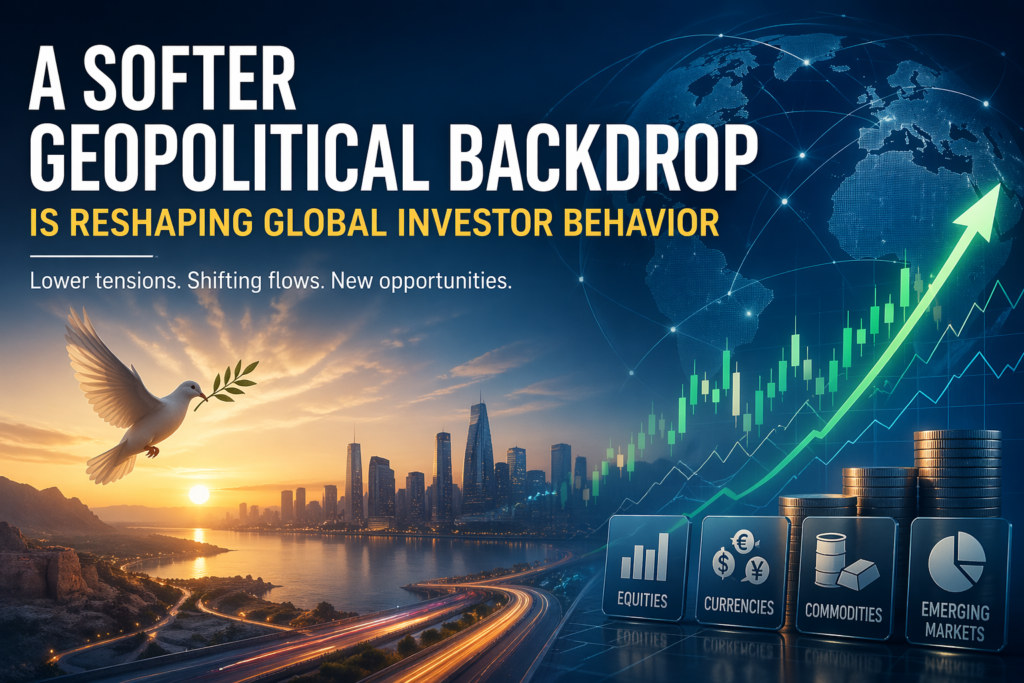
A noticeable shift in geopolitical tensions—particularly in historically volatile regions like the Middle East—is beginning to ripple across global financial markets. As the immediate threat of escalation recedes, investors are recalibrating their strategies, moving away from defensive positioning and toward risk-oriented assets. This transition highlights how sensitive modern markets are to changes in geopolitical risk—and how quickly sentiment can pivot.
From Fear to Opportunity
At the height of geopolitical uncertainty, markets tend to price in worst-case scenarios: supply chain disruptions, energy shocks, and broader economic instability. During such periods, capital flows into so-called “safe-haven” assets—namely the U.S. dollar, government bonds, and gold. These instruments provide stability but often at the cost of lower returns.
However, when tensions ease—through diplomatic progress, ceasefires, or reduced military activity—the perceived probability of these extreme outcomes declines. Investors begin to unwind defensive positions, reallocating capital toward assets that benefit from economic expansion and higher risk tolerance.
The Return of Risk Appetite
This transition is most visible in equity and currency markets. Stocks, particularly in cyclical sectors such as technology, industrials, and consumer discretionary, tend to rally as confidence in global growth improves. Meanwhile, emerging market assets—often more sensitive to global risk sentiment—see renewed inflows.
Currencies follow a similar pattern. The U.S. dollar, which typically strengthens during times of crisis, can weaken as investors rotate into higher-yielding or growth-linked currencies. This shift reflects a broader move toward “carry trades,” where investors seek to capitalize on interest rate differentials in a more stable global environment.
Yield-Seeking Behavior Intensifies
A softer geopolitical backdrop also encourages investors to pursue yield more aggressively. This can involve extending into longer-duration bonds or moving into lower-rated credit instruments. As perceived risk declines, the premium required to hold these assets compresses, making them more attractive relative to safer alternatives.
At the same time, volatility across asset classes tends to decline. Lower demand for hedging reduces options pricing, and market swings become less pronounced—at least temporarily. This creates a feedback loop where reduced volatility further supports risk-taking behavior.
Not a One-Way Trade
Despite the optimism, this shift is inherently fragile. Geopolitical dynamics remain fluid, and any sudden escalation can quickly reverse market sentiment. Safe-haven demand can return almost instantly, pulling capital back into defensive assets and triggering sharp corrections in risk markets.
Investors, therefore, are operating in an environment where headlines carry significant weight. While fundamentals such as interest rates and economic data remain important, short-term market direction is increasingly driven by geopolitical developments.
The Bigger Picture
The current environment underscores a key reality of modern financial markets: risk perception is just as influential as economic fundamentals. A reduction in geopolitical tension doesn’t merely improve sentiment—it actively reshapes capital allocation, compresses risk premiums, and alters the global investment landscape.
For now, the easing of tensions is encouraging a broader “risk-on” posture. But in a world where geopolitical conditions can change rapidly, adaptability remains the most valuable asset in any investor’s toolkit.