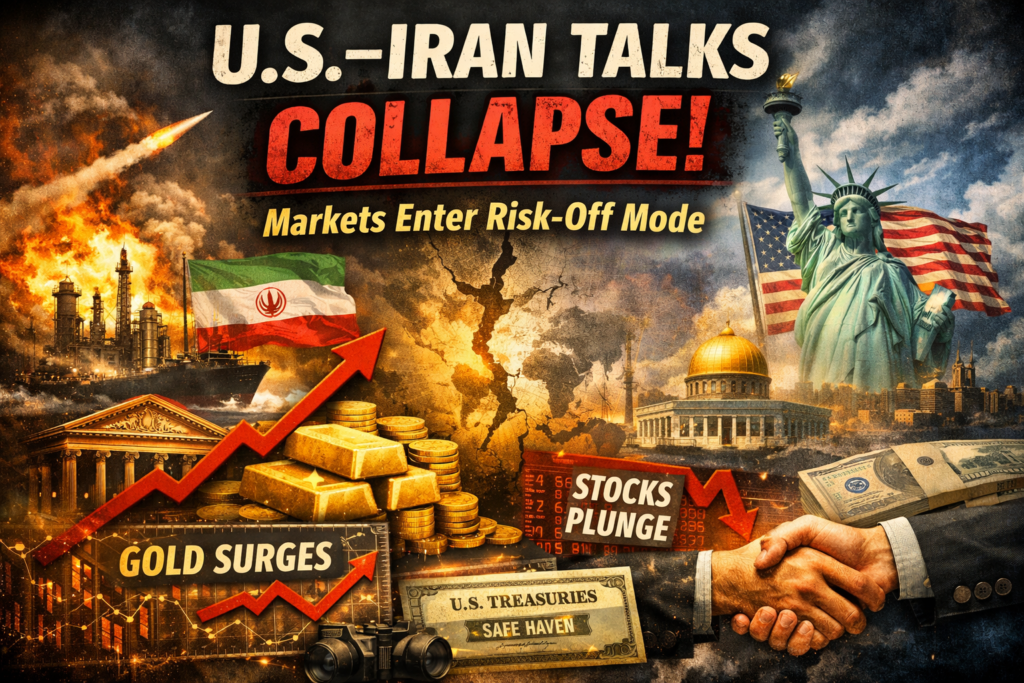
The result is a classic macro reaction: safe-haven demand surges, oil spikes, and the euro weakens—but the full picture is more nuanced than a simple flight to safety.
1. Safe-Haven Demand: Dollar Surges—But Not Cleanly
When negotiations failed, investors rushed into the US dollar, reinforcing its role as the world’s primary safe-haven currency.
- The dollar strengthened immediately after talks collapsed (Reuters)
- Demand was driven by geopolitical fear and capital seeking stability
- Rising oil prices also supported the dollar, especially given U.S. energy independence (MarketWatch)
However, the move isn’t one-directional:
- The dollar has also shown periodic weakness as volatility increases (TMGM)
- It has already given back parts of its “war premium” during temporary calm (Reuters)
👉 Interpretation:
The dollar is strong—but unstable. It’s being pulled between safe-haven demand and shifting expectations around interest rates and growth.
2. Oil: The Core Driver of Everything
Oil is the central transmission mechanism in this crisis.
- Prices surged above $100/barrel after negotiations failed and supply fears intensified (The Guardian)
- The disruption in the Strait of Hormuz has created one of the biggest supply shocks in modern history (Wikipedia)
- Markets remain extremely sensitive to any headline about the strait or military escalation
Oil’s influence extends beyond commodities:
- Higher oil → higher inflation expectations
- Higher inflation → tighter monetary policy
- Tighter policy → stronger dollar
👉 Key insight:
Oil is no longer just reacting to geopolitics—it is driving currency markets directly.
3. Euro Under Pressure
The euro is one of the biggest casualties of this environment.
- It weakens when the dollar strengthens during risk-off events (Forex)
- It is structurally vulnerable to rising energy prices due to Europe’s import dependence
There’s a measurable relationship:
- For every ~10% rise in oil, the euro tends to fall significantly against the dollar (Investing.com South Africa)
Even when the euro rebounds:
- Gains are often fragile and sentiment-driven, not fundamental
- Elevated energy costs continue to act as a drag
👉 Interpretation:
The euro is caught in a double bind:
- Weak against the dollar (safe-haven flows)
- Weak against oil (energy dependency)
4. Market Structure: Why Volatility Is Here to Stay
This is no longer a short-term shock—it’s becoming structural.
Three forces are now locked together:
Geopolitics → Oil
Failed negotiations → supply fears → oil spikes
Oil → Inflation
Higher oil → persistent inflation pressure
Inflation → Currency Moves
- Supports USD (higher rates)
- Weakens EUR (economic strain)
Even temporary ceasefires don’t resolve this cycle:
- Oil remains volatile
- Safe-haven demand returns quickly
- Markets swing between optimism and fear
5. The Key Market Signals to Watch
To understand where markets go next, focus on:
- Oil prices → the most important real-time signal
- Dollar index (DXY) → reflects global risk sentiment
- EUR/USD → shows pressure from both energy and capital flows
- Negotiation headlines → trigger short-term volatility
Conclusion
The breakdown in U.S.–Iran negotiations has triggered a classic but complex macro response:
- US Dollar → strengthened by safe-haven demand, but volatile
- Oil → surging and driving inflation + global risk
- Euro → weakening under pressure from both energy costs and capital flows
The key takeaway:
👉 This is not a temporary spike—it’s a structurally fragile environment.
As long as geopolitical tensions persist, markets will remain headline-driven, oil-sensitive, and highly volatile.